
Tracking Student Achievement with Pass-offs
Jul 01, 2026
Estimated Read Time: 5 minutes
By Rob Chilton
In July 2024, I published Pass-offs: Accountability, Motivation, & Self-Directed Learning introducing my weekly routine:
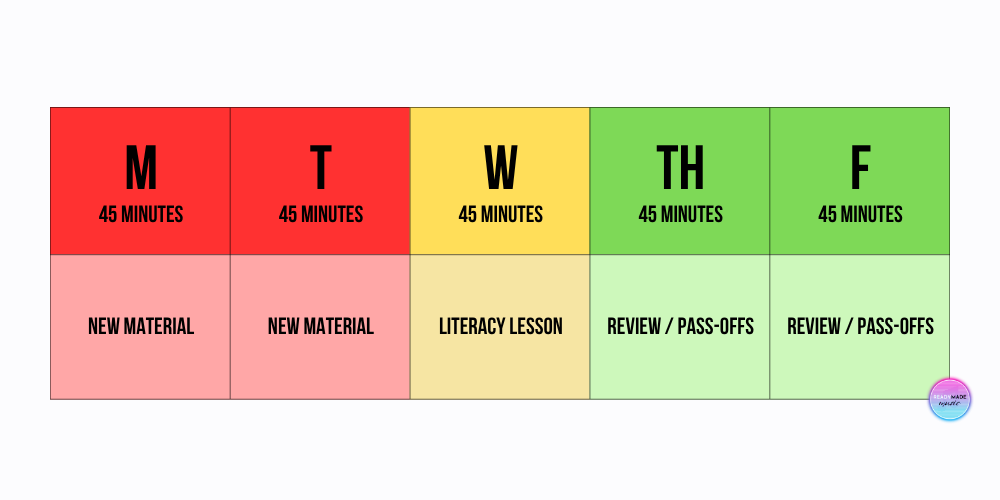
And my pass-off sheet and motivational locker ribbons:
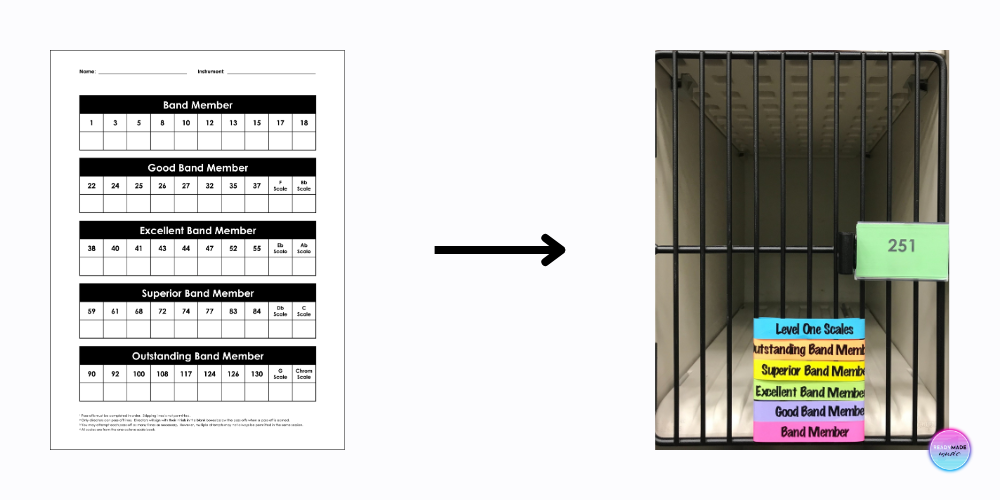
In this post, I want to follow up by showing how I tracked student achievement and used that information to keep all students moving forward.
Even if you haven’t read the earlier post, this one is designed to stand on its own. You can go back and catch up at any time.
Tracking Student Achievement
I tracked student achievement using a simple Google Sheet. Student names were listed on the left, and the corresponding lines from the method book or scales were listed across the top.
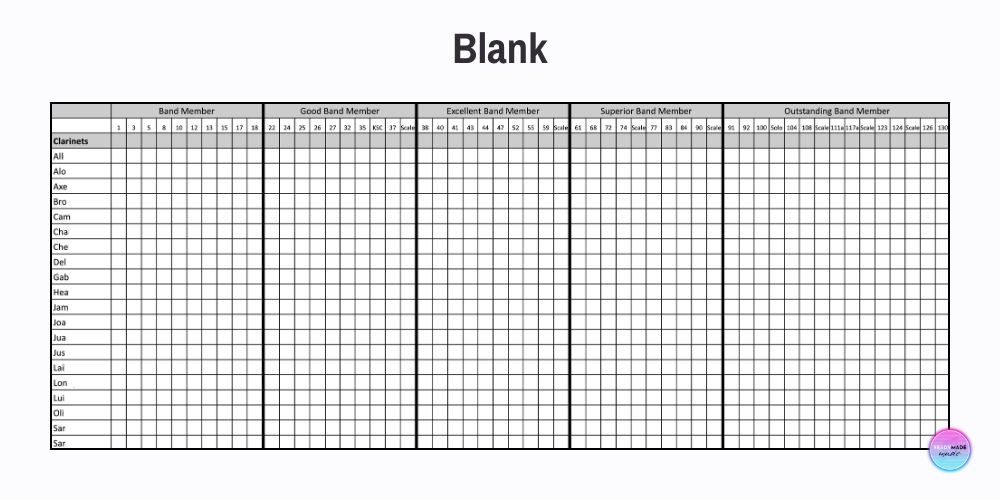
Two things I tracked were:
- The lines or scales I had taught, which I showed by coloring the cells beneath each line solid black.
- The lines students passed off, which I showed this by coloring the corresponding cells the color for that term.
Here’s real data from my beginning clarinet class from a few years back, with student names modified for anonymity.
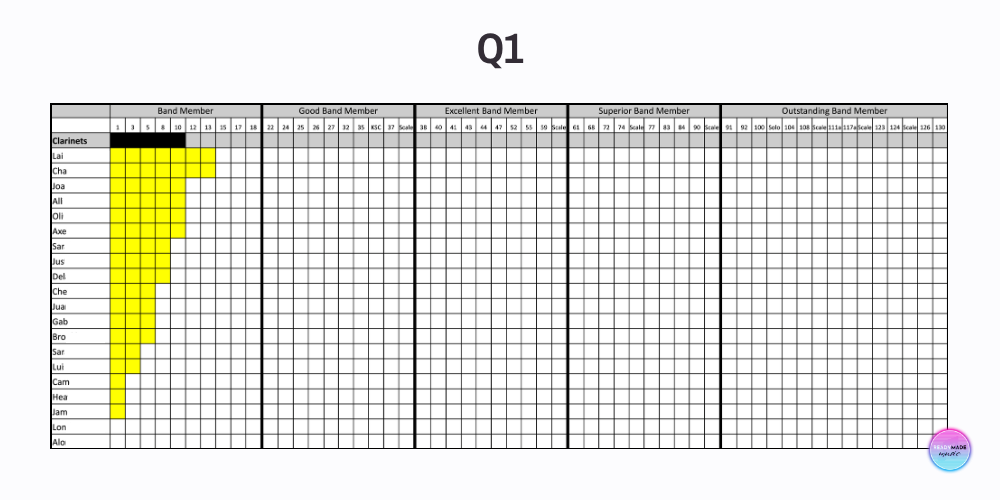
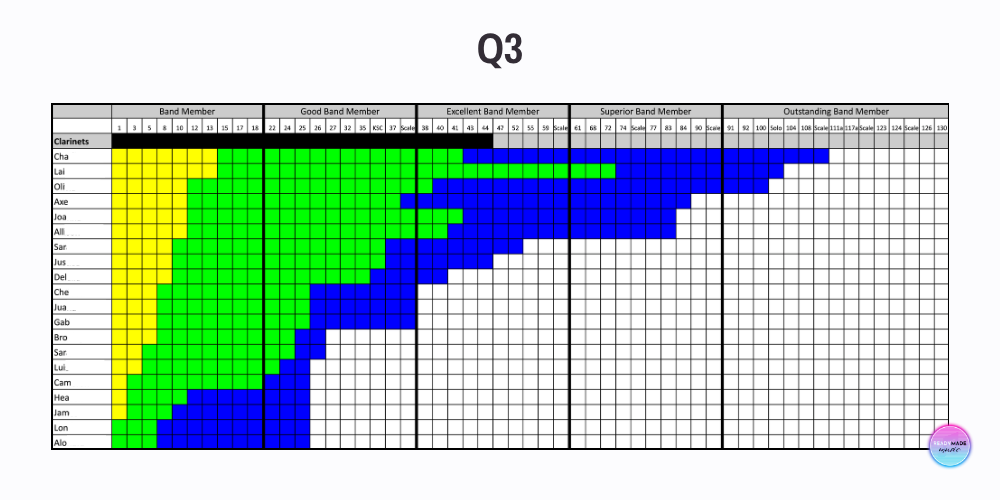
Because this was a Google Sheet, I could easily rearrange the rows. I dragged individual rows up or down in real time with the most completed on top so I could see the class’s curve of achievement.
Here’s the progress at the end of Q2, Q3, and Q4.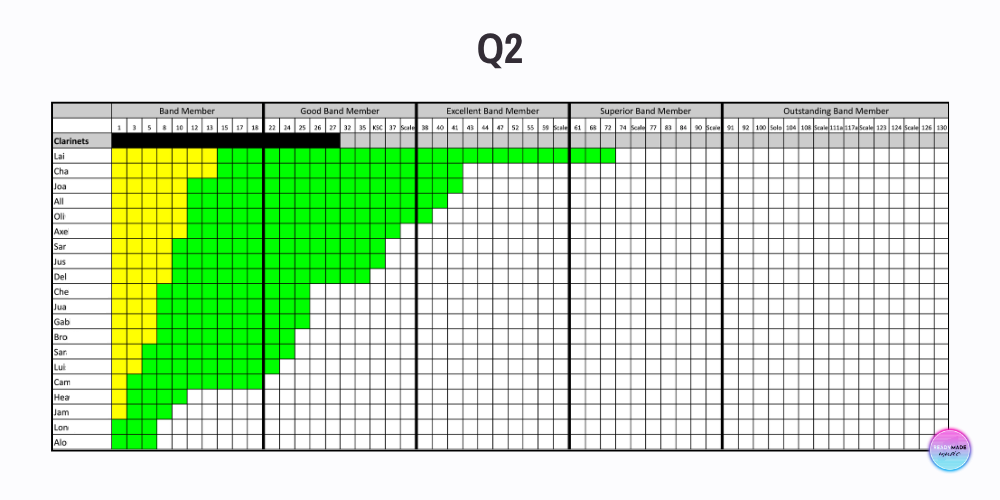
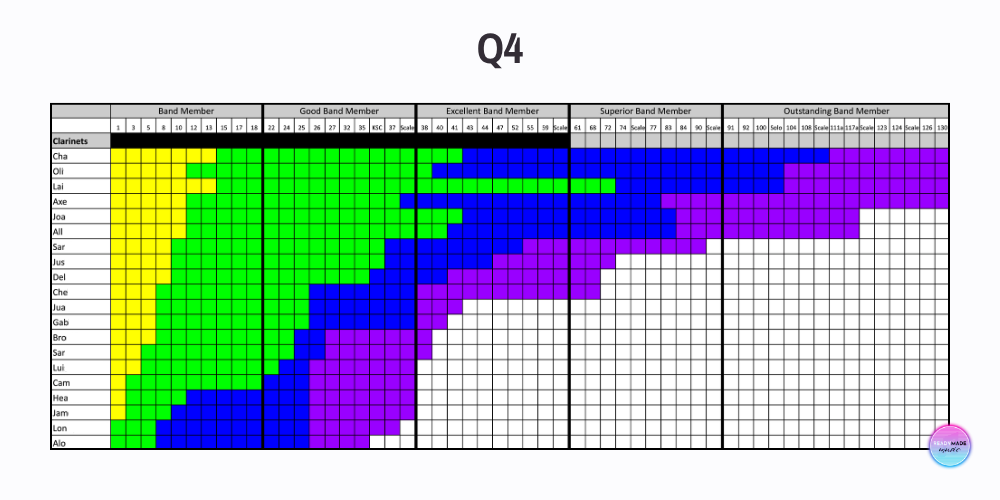
The Curve of Achievement
In a perfect world, everyone would progress at the same pace.
But that’s not reality.
Students spread out over time. Some move quickly. Some need more repetition. Some develop learning gaps, which are areas of missing information or understanding that make it harder to keep up with the new instruction. In the worst case scenario, a student could become immeasurable behind or lost.
With this pass-off system, a student is never too lost to progress because they always know what’s next. There’s a simple path forward.
And with the tracking method, you can easily see where every child is—and whether they are progressing or stalled. With that information you can easily choose to review skills or target material that is most likely to move them forward.
My Most Effective Way to Conduct Pass-offs
My most consistent and effective approach was to start pass-offs on Thursday with the lowest line and work my way through the class over one or two days.
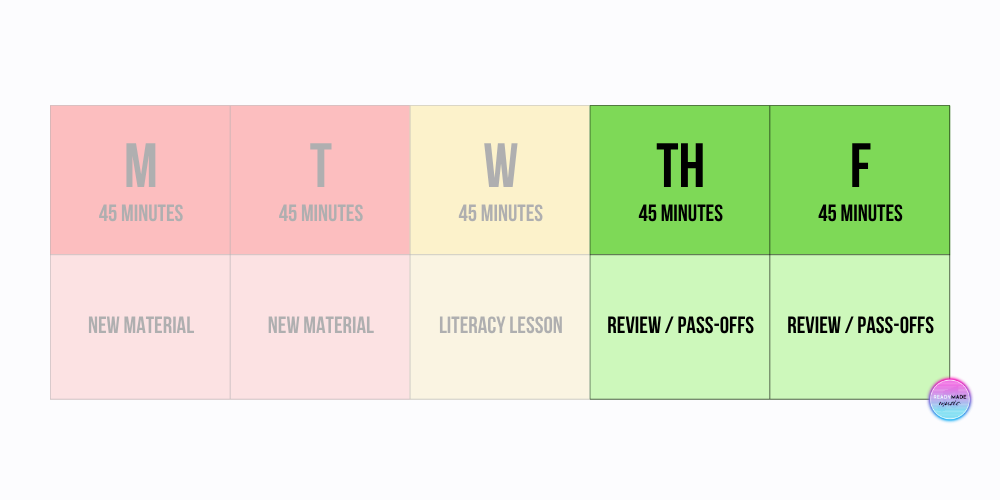
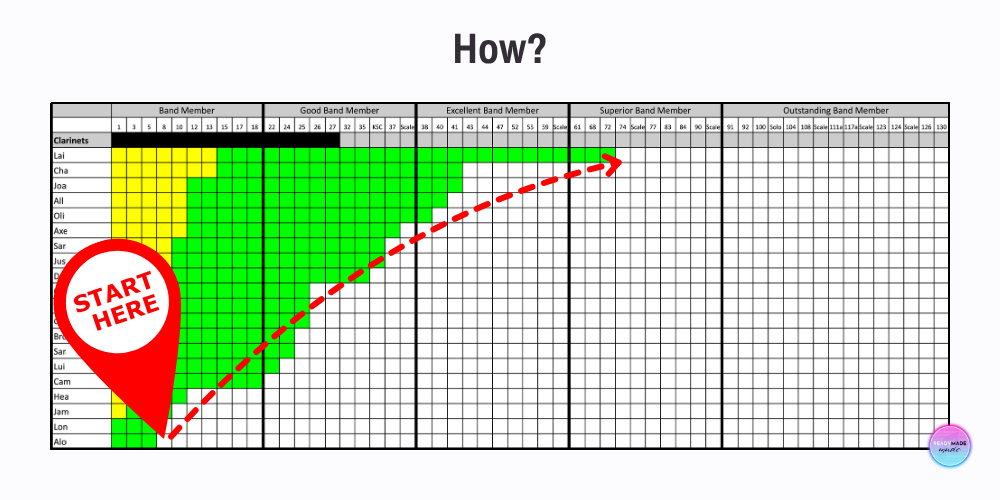
We’d play each line together, review a few key elements, and then give that student a chance to pass it off. Then we’d move to the next line, repeating the process and working our way through the class.
This method did two important things at the same time. First, it helped students who needed the most support continue making progress. Second, it reinforced fundamentals and reading for everyone. Even students who had already passed off a line benefited from revisiting it with greater fluency, confidence, and control.
Not to mention, once students realized they were going to play the same line each week until it passed, they were more likely to practice at home. Or, at the very least, they were more willing to complete focused repetitions in class.
Demonstrating Mastery at a Differentiated Pace
It’s worth pointing out that by the end of the year I only reached line #59 in the method book, yet more than half of my class had taken the initiative to push ahead.
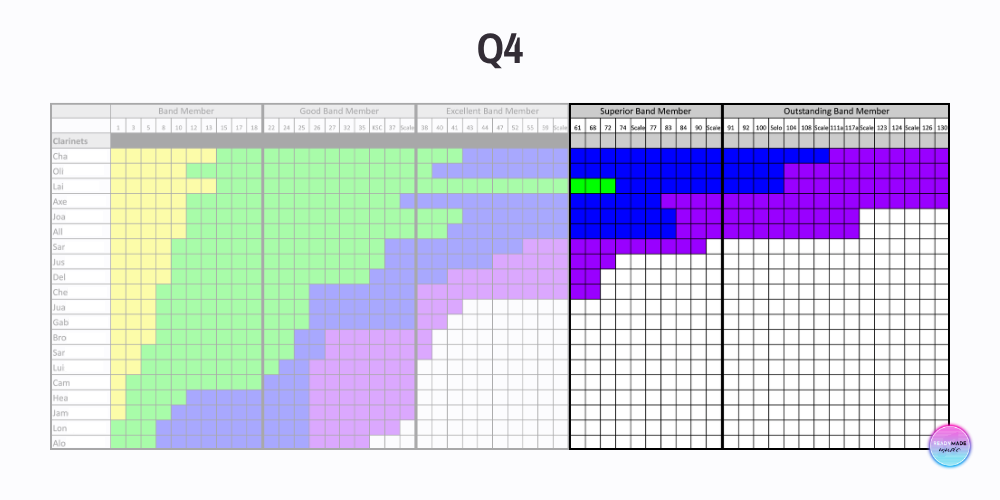
And the students who were behind my instructional pacing weren’t ill-equipped to advance to the next school year. They had demonstrated mastery too, just at a differentiated pace. They were fully capable of returning the next year as productive members of our non-varsity ensembles, where they would continue developing their skills alongside peers with similar ability levels.
Self-Sufficient Musicians
Do you want students to become more self-sufficient and self-directed?
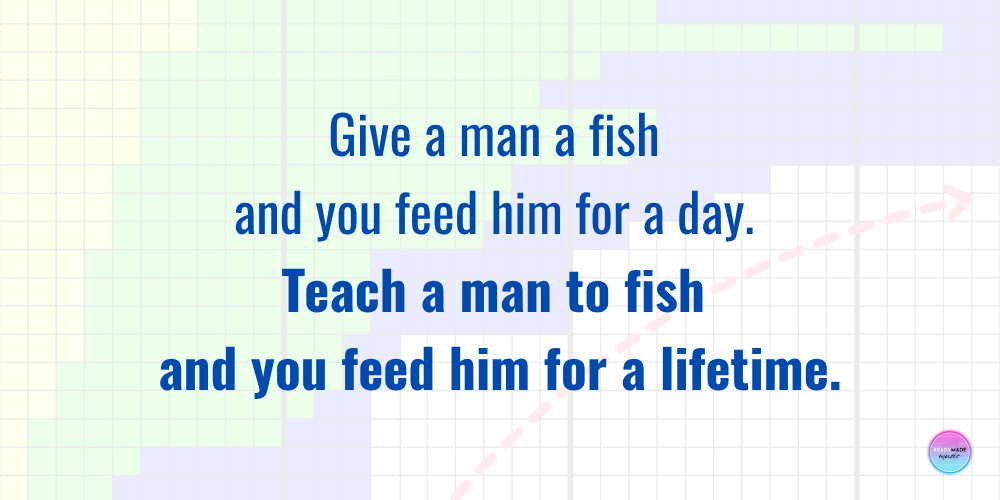
Then we must teach them how to teach themselves.
The pass-off sheet gives students direction, but self-sufficient musicianship requires more than knowing what line comes next. Students also need a deep understanding of the musical language itself. They need to understand how to decode sheet music, much like how they use phonics to decode written language.
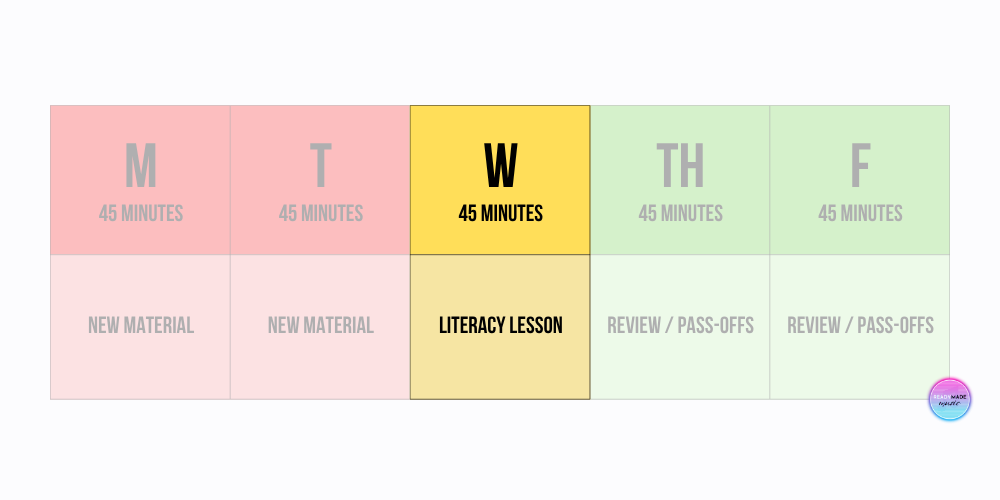
I began investing regular time in music literacy instruction on Wednesdays or Thursdays. These were non-playing lessons where we progressed through:
- Rhythm
- Staff notation
- Piano keyboard identification (for chromaticism and enharmonics)
- Basic musical vocabulary
- Simple compositional skills
We also introduced concepts ahead of where we were in the method book. This gave students the tools to progress more independently and reduced hurdles in the instructional process.
Note: While these lessons did take time away from playing, the benefit was that students gained the knowledge and confidence to try learning new material on their own, rather than always relying on me to show them “how it goes.” Ultimately, this led to more productive practice at home and higher achievement.
Check out our music literacy method!

Final Thought
Your data should tell you the basic idea at a glance. Keep it simple and essential. More data is only useful if it's quick and easy to synthesize.
Stay tuned! Next we’ll discuss:
- Further managing the curve of achievement
- How much feedback to give
- Connecting pass-offs to grades
- What to do when students complete the entire sheet
- …and much more!
I hope you find it helpful. ✌️
Related posts:
Suggested post:
Never miss a new posting!

Learn about Readymade Music Literacy:

About the author:

Rob Chilton is the creator and owner of Readymade Music, LLC and its content. Previously, Chilton was a middle school band director from 2007-2021. His most recent teaching position was the Head Band Director at Killian Middle School in Lewisville, Texas from 2014-2021.
Under his direction, the Killian Honors Band was named the 2018 Texas Music Educators Association CC Honor Band and performed at the annual 2018 TMEA Clinic/Convention. In 2019, the Killian Honors Band was invited to and performed at The Midwest Clinic in Chicago. Additionally, the Killian Honors Band was named a National Winner in the Mark of Excellence National Wind Band Honors Project in 2015, 2016, 2017, 2018, and 2019.
Chilton is a graduate of Southern Methodist University where he had the opportunity to study music education with Lynne Jackson and Brian Merrill. During his years as a middle school band director, Chilton continued his professional growth under the guidance of his primary clinicians, John Benzer and Brian Merrill.
Chilton’s mission for Readymade Music is to promote the overall well-being of music education and support school music teachers by providing solutions to help make teaching music more efficient and inspirational while increasing engagement for 21st century learners.

© 2026 Readymade Music, LLC
All rights reserved.
The unauthorized distribution and/or reproduction of this work is illegal.
