
Preparing Students for All-Region: A System That Works
Aug 01, 2026
Estimated Read Time: 5 minutes
By Rob Chilton
Each August, we hand students the most difficult music they'll likely see all year:
The all-region audition music.
For many, it looks completely out of reach. And when students believe something is impossible, they're already behind before they've played the first note.
Preparing students for All-Region isn't just about teaching difficult music. It's about (a) giving them a system for learning it, and (b) preparing them for the experience of auditioning.
Here's the process that worked best for my students.
The Obvious Hurdles
Let’s start by stating the obvious:
- The music is challenging.
- There’s limited time to learn it.
First, I remind students that the music is supposed to be hard. If it were easy, everyone would prepare and perform it at such high levels it would be difficult to distinguish between players.
Second, there’s a deadline and the music can't be crammed. It must be introduced early, practiced consistently, and performed repeatedly under audition conditions.
From the very beginning, I want students to understand that success won't come from a few great practice sessions. It'll come from steady work over time.
Discuss, Reflect, & Goal-Set
Before we begin learning the music, I want students thinking intentionally about the process. To do this, I spend about ~30 minutes at the end of the first week of school talking with them in-class about the All-Region experience.
We discuss what it is, how it works, why we do it, and I leave plenty of time for questions. Then, students complete a short reflection and goal-setting activity, which includes answering three questions on paper:
- What is your biggest takeaway from today's discussion?
- What would you still like to know?
- Based on what you know today, what is your goal for the All-Region process? (Example responses include: Have a good audition, make a band, make the top band, make the top three chairs, make 1st chair, etc.)
Then, I collect and read their responses. They always tell me a great deal about how well they understand the process and where their mindset is heading.
Instrument-Specific Rehearsals
If you want or expect a large number of students to audition, you need enough rehearsal time to sufficiently prepare the music. And because the music is often instrument-specific, it’s difficult to cover it in-class in a full-ensemble setting.
You need time with each instrument group.
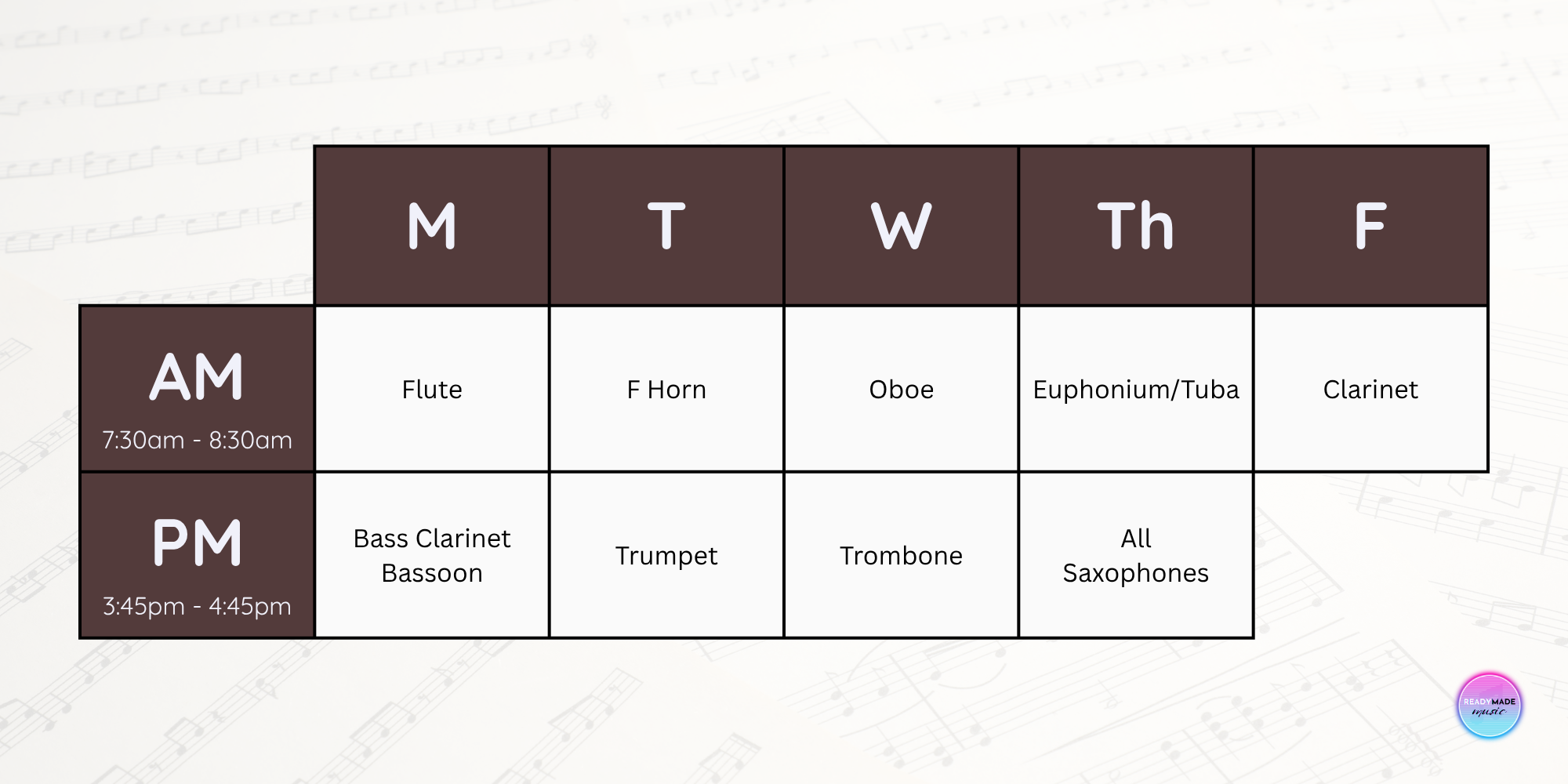
To do this, I recommend having a weekly sectional schedule where each instrument group can meet for about an hour. I did this before and after school, but you could also do this in-class if you have enough instructors and space.
Here’s an example of my sectional schedule:
Tip: Keep these rehearsals focused exclusively on the audition material. Anything that can be taught during full ensemble should stay in full ensemble. And I recommend doing a very short warm-up, or letting your students warm-up on their own for a couple minutes, before diving straight into the material for the week.
Making the Music Feel Manageable
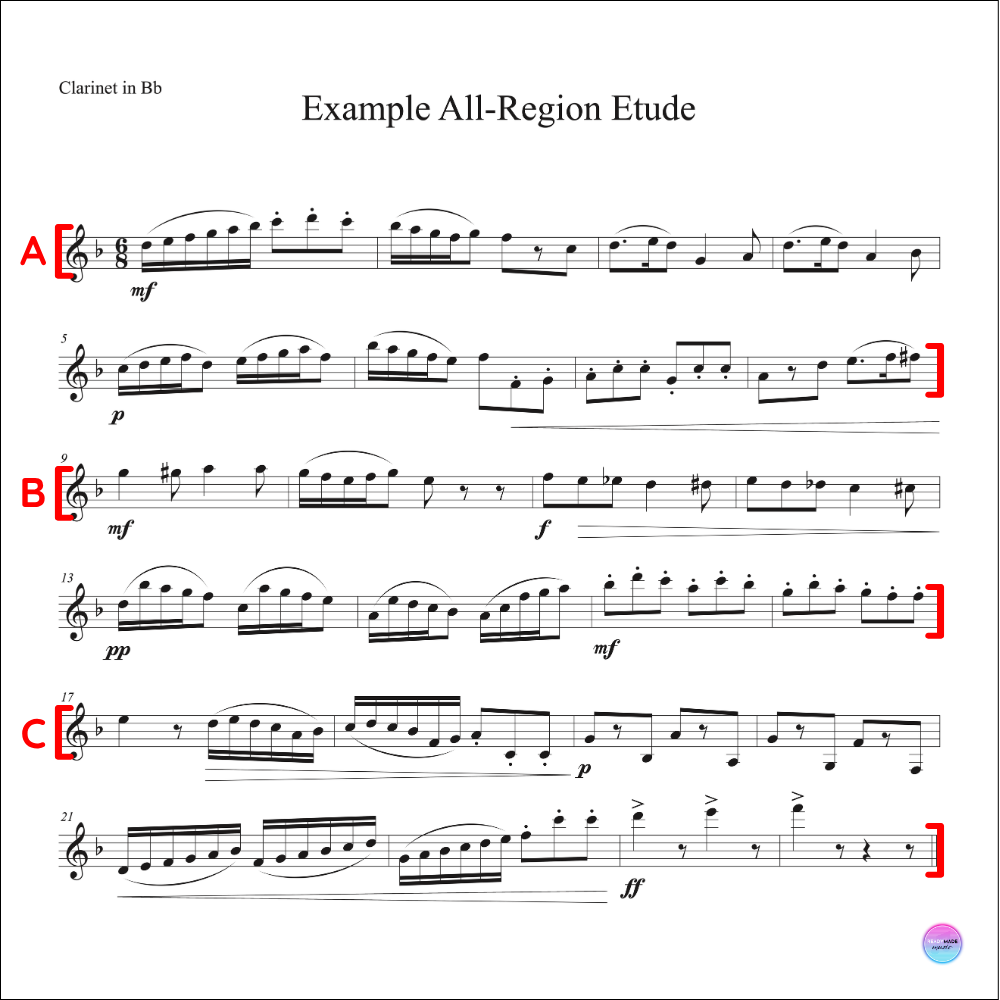
One of the simplest ways to make something challenging feel more achievable is through a strategy called chunking—breaking a large task into smaller, more manageable pieces. And that's exactly how I approach All-Region music.
I start by dividing the etudes up into smaller cuts like this:
Then, I create a schedule for introducing the material, which I map out in a sectional syllabus that I also give to my students.
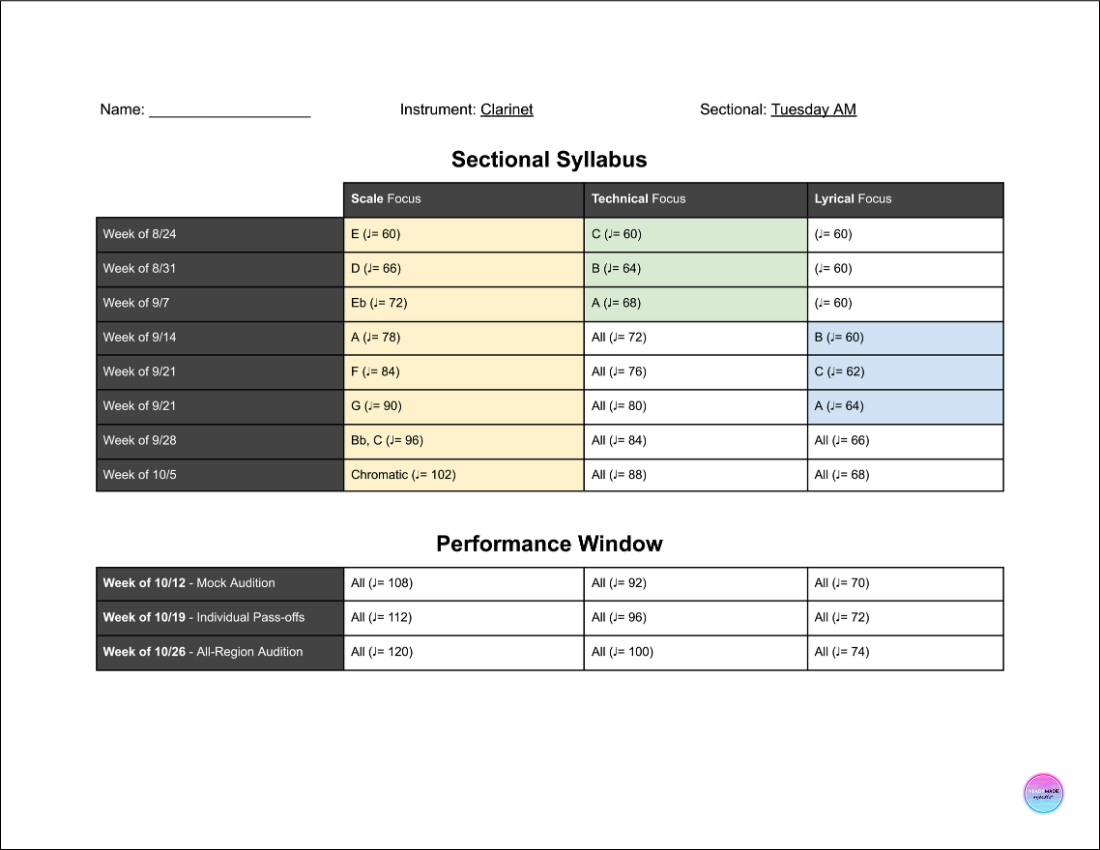
The syllabus keeps me on track, helps students understand the pace of the learning process, and reduces anxiety. Instead of feeling overwhelmed by an entire packet of music, students realize they only need to learn a couple scales and a small section of music each week.
Bonus Tip: If your program has private lessons (and I realize many don't), give your lesson teachers a copy of your sectional syllabus and ask them to stay one section ahead—or work on different material than you're covering in sectionals. For example, if you're teaching the technical etude first, they can focus on the lyrical etude first. This way, students are exposed to all the music faster.
Check out our music literacy method!

Early Exposure Beats Early Perfection
I teach the hardest scales and cuts first because (a) they're the most likely to appear in the audition and (b) they require the most time to master.
But what if students don't learn the scale or cut this week? Do we still move on the following week?
Yes. I believe we should.
One of the biggest mistakes I made early in my career was waiting too long to move on. Unfortunately, audition season doesn't give us that luxury. Every week we delay introducing new material is one less week students have to practice it on their own.
Getting students to mastery is a shared responsibility. I tell my students:
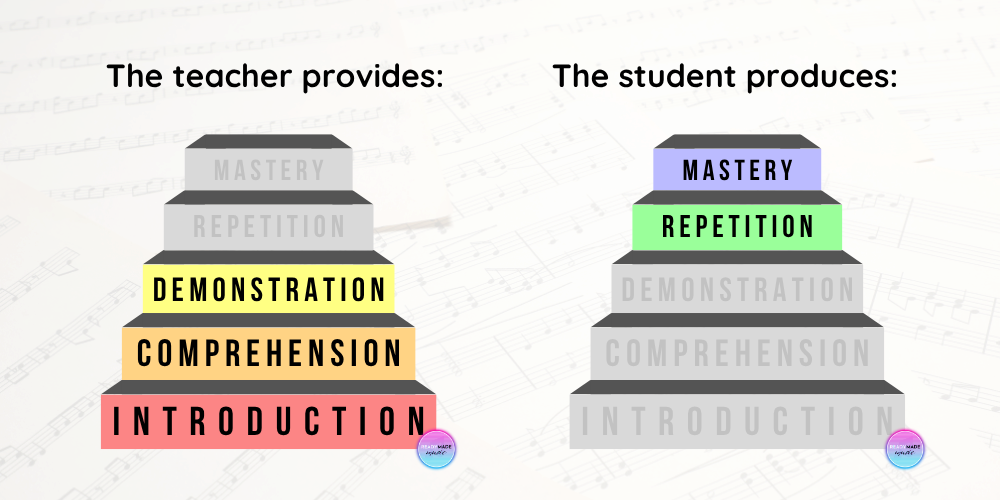
- The teacher’s job is to introduce the material, build comprehension, and create opportunities for students to demonstrate what they've learned.
- The student’s job is repetition through consistent practice—and eventually, achieve mastery.
If you'd like to read more about this philosophy, check out my article, Skill Development: The 5 Steps to Mastery.
The Value of a Mock Audition
About two weeks before the actual audition, organize a mock audition and run it exactly like the real thing. It can take place on your own campus during students' normal sectional time, but it needs to feel authentic.
Have signs for your audition rooms, post the scales and cuts, have students follow the proper check-in procedures, and hang a curtain to block the view between you and the students. The value of this experience cannot be overstated.
- Students get to practice the process.
- They get to practice performing under pressure.
- They get to practice recovering from mistakes.
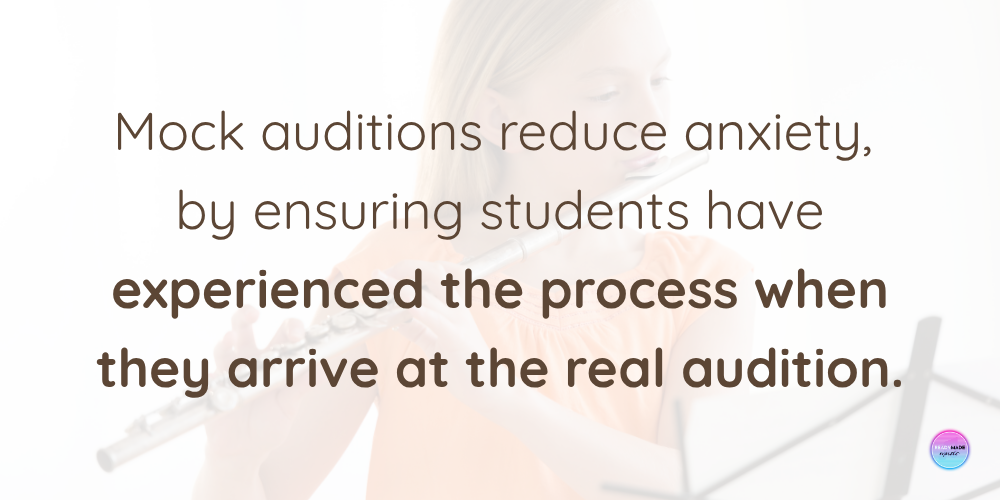
Most importantly, mock auditions reduce uncertainty. By the time they arrive at the real audition, they've already experienced the process once before. Instead of spending precious mental energy figuring out what to do, they can focus entirely on performing.
Final Thoughts
We're doing more than preparing students for an audition. We're teaching them how to approach challenges. Learning to divide large tasks into manageable chunks, practice consistently over time, and trusting long-term processes are skills that extend far beyond All-Region season.
And for us, preparing students for All-Region isn't about spending weeks on the same cut only to cram as much information as possible into a few remaining rehearsals. It's about setting up a system that consistently moves students through the material so they're better equipped come audition day.
Stay tuned for Part 2 next month. We'll look at how to structure rehearsals so every sectional is purposeful, efficient, and focused on long-term growth over short-term survival.
Thanks to Sarah Saldaña for suggesting this topic.

Related reading:
Suggested post:
Never miss a new post!

Learn about Readymade Music Literacy:

About the author:

Rob Chilton is the creator and owner of Readymade Music, LLC and its content. Previously, Chilton was a middle school band director from 2007-2021. His most recent teaching position was the Head Band Director at Killian Middle School in Lewisville, Texas from 2014-2021.
Under his direction, the Killian Honors Band was named the 2018 Texas Music Educators Association CC Honor Band and performed at the annual 2018 TMEA Clinic/Convention. In 2019, the Killian Honors Band was invited to and performed at The Midwest Clinic in Chicago. Additionally, the Killian Honors Band was named a National Winner in the Mark of Excellence National Wind Band Honors Project in 2015, 2016, 2017, 2018, and 2019.
Chilton is a graduate of Southern Methodist University where he had the opportunity to study music education with Lynne Jackson and Brian Merrill. During his years as a middle school band director, Chilton continued his professional growth under the guidance of his primary clinicians, John Benzer and Brian Merrill.
Chilton’s mission for Readymade Music is to promote the overall well-being of music education and support school music teachers by providing solutions to help make teaching music more efficient and inspirational while increasing engagement for 21st century learners.

© 2026 Readymade Music, LLC
All rights reserved.
The unauthorized distribution and/or reproduction of this work is illegal.
