
Marches Are Hard: Four Common Problems
Jan 01, 2026
Estimated Read Time: 5 minutes
By Rob Chilton
In Texas, we’re required to play a march for our statewide evaluation every spring. For a long time, I hated playing traditional marches with my middle school band. Don’t get me wrong—I understand their history and importance. I just never enjoyed teaching them because they always came off loud and noisy, even when the notes and rhythms were correct.
Over the years, I’ve tried everything to avoid playing a traditional march. I’ve done numerous Paso Dobles, and even tunes with the word “march” in the title, such as Nelhybel’s March to Nowhere—which is totally cool, but absolutely not a march. It took me about 10 years of teaching before I finally figured out how to make traditional marches sound good—and once I did, I fell in love with them.
In this article, I’m going to briefly address four areas where marches are difficult—and what to do about them. Each of these will be their own standalone article in the future, but for this post, my goal is just to briefly cover them.
Problem #1
Problem: Marches are often harder than same-level concert selections.
A Grade 2 march is often more challenging than a Grade 2 concert selection. One reason for this is that the non-melodic lines are often more challenging and involved in a march. For example, in your average concert selection, the low brass might have basic accompaniment parts, but in a march, they’re likely carrying a more involved countermelody or supporting line.
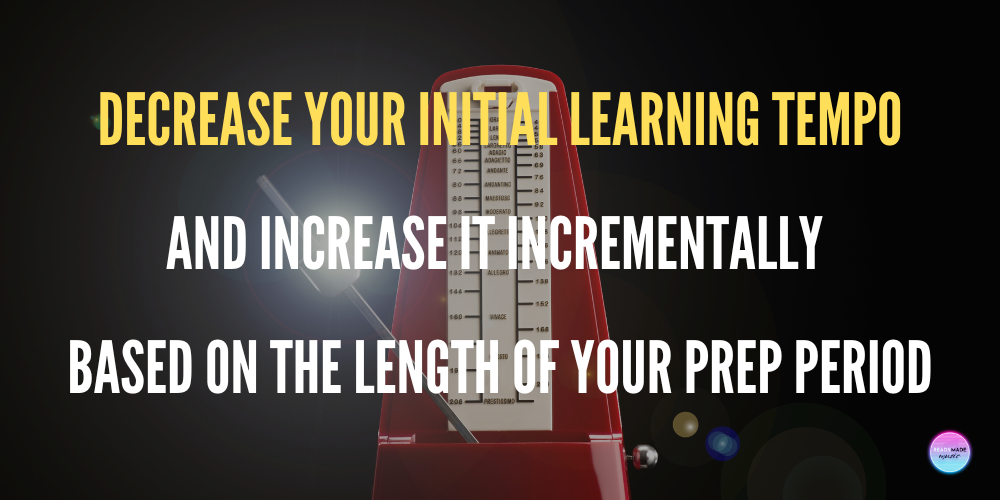
Solution: Decrease your initial learning tempo and increase it incrementally based on the length of your prep period.
Especially with younger students, I recommend starting your march at 60–75% of full tempo. For example, if my goal is 120 bpm, I’ll start teaching it at 72 bpm. Then, I’ll increase the tempo a little each time we rehearse it—usually 3-4 bpm. The amount I’ll increase depends on how much time we have to be performance-ready. My goal is to reach full tempo two weeks before a performance so the kids have time to practice at full speed—and settle into their final tempo.
Problem #2
Problem: March style isn’t notated—and explaining it can be a challenge with younger students.
The problem with style is that it isn’t often written on the page. It’s up to us to apply it intuitively. As seasoned musicians, we know this—but for young musicians, it’s not yet automatic, and explaining it can be a challenge.
Solution: Simplify march style by explaining two things: articulation strength and lift.
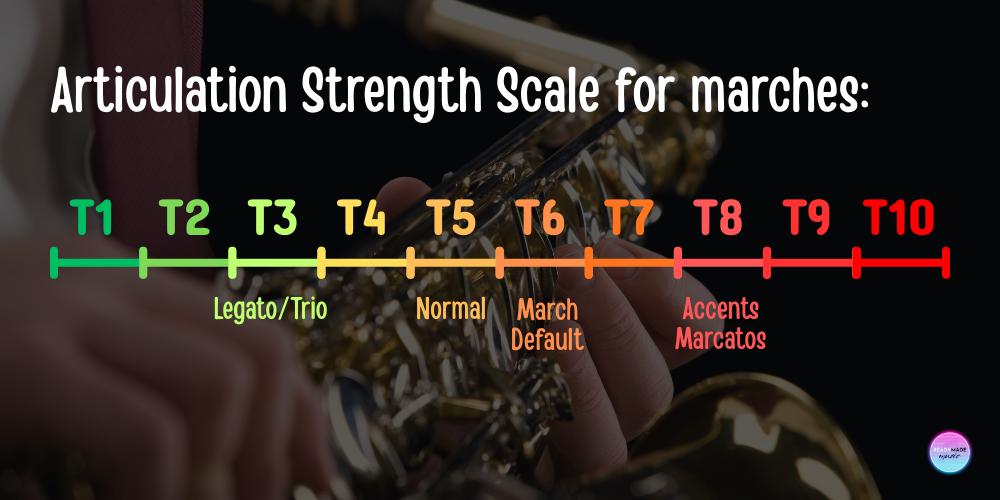
To explain articulation strength, I use a numbered scale where T1 is the most light and gentle, and T10 is the most firm and accented. (The letter “T” stands for “tongue.”) I generally use T5 as our default strength, but in a march I’ll ask my students to increase their default to T6 to create a firmer front to each note. Then, I’ll have them use T8 for accents. We might also utilize T3 for a legato passage in the Trio.
Explaining lift is more challenging and nuanced—but it’s basically separation between notes. In a cut-time march, my preference is the following:
- Whole notes and half notes are full value
- Quarter and eighth notes are played staccato
It should be noted that this is an oversimplification of style and lift, and we’ll get into the nuances more in the future. But this works for giving young students the general idea—especially if you already work on lifted note values in your ensemble fundamentals warm-up.
Problem #3
Problem: The march sounds loud and noisy.
Marches often sound loud and noisy because everyone’s playing—and the number of players on non-melodic lines often outnumbers those on the melody. For example, 15 players might have the melody, while 45 are on other lines—countermelodies, downbeats, upbeats, etc.
Solution: First balance the musical lines, then balance the orchestration.
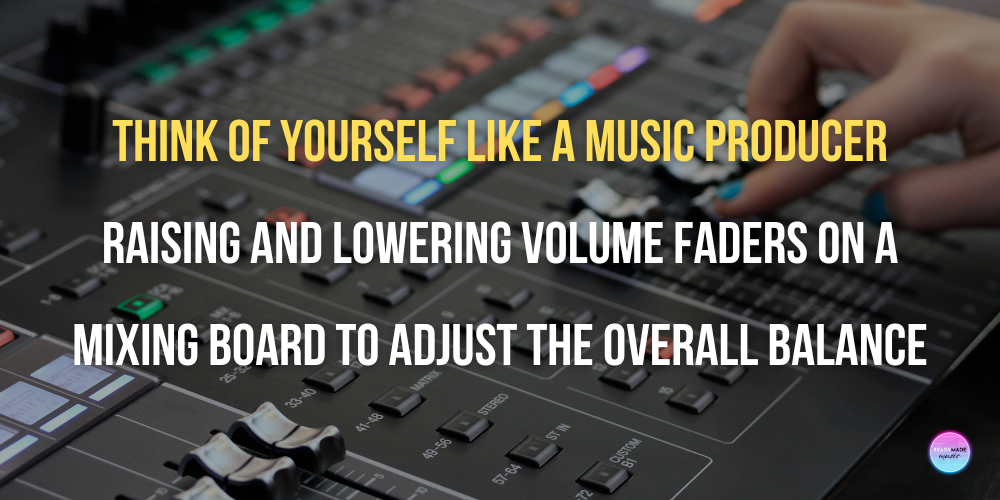
First, balance the musical lines by asking the melody to play by themselves. Then, layer in the non-melodic lines one at a time at volumes softer than the melody until you find your preferred ensemble sound. Think of yourself like a music producer raising and lowering volume faders on a mixing board to adjust the overall balance.
Second, balance the orchestration—meaning adjusting the mix of the instruments assigned to each musical line. For this, I have two rules of thumb:
- Balance each musical line to its lowest octave
- Balance each musical line to a brass instrument
For example if the flute/clarinet/trumpet has the melody, I’ll balance it trumpet > clarinet > flute. You can do this by having the trumpets play by themselves. Then, layer in the clarinets one dynamic softer than the trumpets—followed by the flutes one dynamic softer than the clarinets.
Check out our music literacy method!

Problem #4
Problem: Marches are often mentally and physically exhausting for the performer.
Unlike your average concert selection—where the orchestration from passage to passage might be slimmer, resulting in multi-measure rests more often—marches commonly require every section to play the entire time. This can lead to endurance issues, both physical and mental.
Solution: Do more full run-throughs—or even double run-throughs.
Once you can play through your march, make it a habit to play it from start to finish often—even if it’s still under tempo. Students need to build mental and physical stamina, and they don’t get it from rehearsing chunks. As your performance nears, try having your students play the march straight through twice. They’ll likely groan about this—mine did—but if they can make the second pass sound good, then you know they have the endurance to play it well the first time on performance day.
Final Thoughts
Something I’ve learned is that our mindset becomes our reality. Whether we’re excited about a piece—or not—will manifest in the way we rehearse it. This, in turn, influences our students, as they often mirror our feelings and attitudes—especially the younger ones. It’s important and necessary for us to approach every piece we’re playing with effort and enthusiasm.
It’s also worth remembering to spend enough time on literature selection. There’s nothing worse than discovering too late that a piece we chose isn’t a great fit for our ensemble. Our literature choices become our curriculum for weeks and months at a time—choose wisely!
Related post:
Never miss a new posting!

Check out this short video!

About the author:

Rob Chilton is the creator and owner of Readymade Music, LLC and its content. Previously, Chilton was a middle school band director from 2007-2021. His most recent teaching position was the Head Band Director at Killian Middle School in Lewisville, Texas from 2014-2021.
Under his direction, the Killian Honors Band was named the 2018 Texas Music Educators Association CC Honor Band and performed at the annual 2018 TMEA Clinic/Convention. In 2019, the Killian Honors Band was invited to and performed at The Midwest Clinic in Chicago. Additionally, the Killian Honors Band was named a National Winner in the Mark of Excellence National Wind Band Honors Project in 2015, 2016, 2017, 2018, and 2019.
Chilton is a graduate of Southern Methodist University where he had the opportunity to study music education under the tutelage of Lynne Jackson and Brian Merrill. During his years as a middle school band director, Chilton continued his professional growth under the guidance of his primary clinicians, John Benzer and Brian Merrill.
Chilton’s mission for Readymade Music is to promote the overall well-being of music education and support school music teachers by providing solutions to help make teaching music more efficient and inspirational while increasing engagement for 21st century learners.

© 2026 Readymade Music, LLC
All rights reserved.
The unauthorized distribution and/or reproduction of this work is illegal.
