
From Rough to Polished: Using Individual Pass-offs to Transform Contest Prep
Feb 01, 2026
Estimated Read Time: 5 minutes
By Rob Chilton
February is difficult. With contests and evaluations looming, the pressure to be performance-ready increases daily. Yet, it often seems we’re the only ones feeling the urgency. Even when our rehearsals are masterfully planned, it frequently feels as if we’re waiting for our students to take ownership and not just learn, but master their parts. What can we do?
One solution is to have your students pass-off their parts—individually. It can help them take responsibility for their role in the ensemble, create shared ownership for the upcoming performance, and result in a more rewarding experience for everyone. It can also help a slowed or stalled ensemble get moving again and go from rough draft to fully polished in a matter of days or weeks—something I’ve been surprised to witness time and again.
In this post, I’ll break down my process for individual pass-offs for contest—and how you can apply them to your group.
Methods
There are two basic ways you can have your students pass-off their contest music:
- In-person (either in-class or before/after school)
- Remotely (with audio/video or a web-based software)
I’ve done it both ways, but primarily use in-person pass-offs for spring contest preparation. They work especially well because they allow us to hear every student in isolation, develop a clearer picture of the ensemble’s strengths and weaknesses, and provide feedback that is both specific and personal. Just as importantly, they create opportunities to acknowledge effort, guide improvement, and strengthen one-on-one teacher–student relationships.
Scheduling
With in-person pass-offs, you’ll need two things:
- A director to hear the pass-offs
- A schedule or dedicated allotment of time
With the varsity band, I often handle all pass-offs myself before or after school. I do this by canceling sectionals for two weeks and instead having students attend a 7-minute pass-off appointment. For scheduling, I let students choose their own time slot using SignUpGenius, a Google Sheet, or—sometimes—simply a paper sign-up on a clipboard passed around the room.
With the non-varsity band, I often have an assisting director hear students during class time. Sometimes that assisting director is myself or an associate; other times, it’s a visiting high school director. The important thing is that no matter who is hearing the pass-offs, the procedure and standard remain aligned. In this setting, I don’t have students sign up for appointments. Instead, the assisting director receives a clipboard with a list of students to pull one by one.
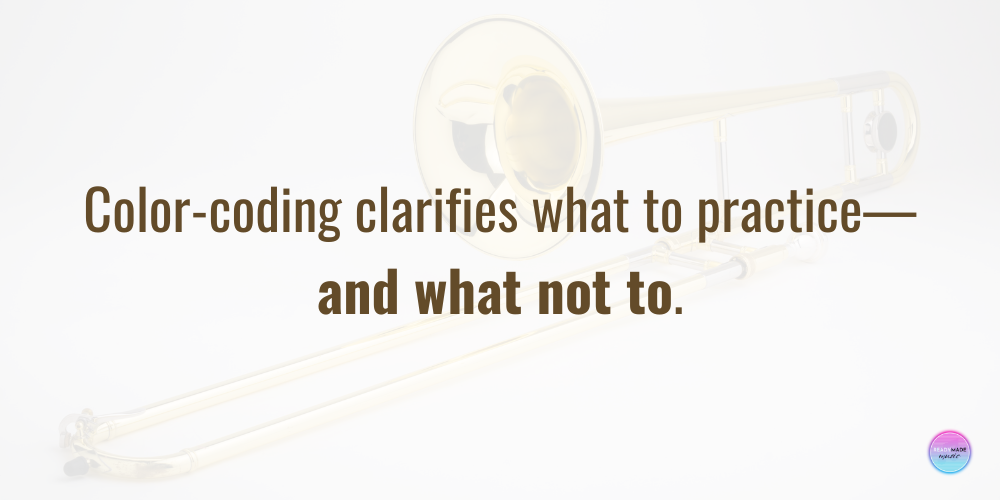
Color-Coded Practice Targets
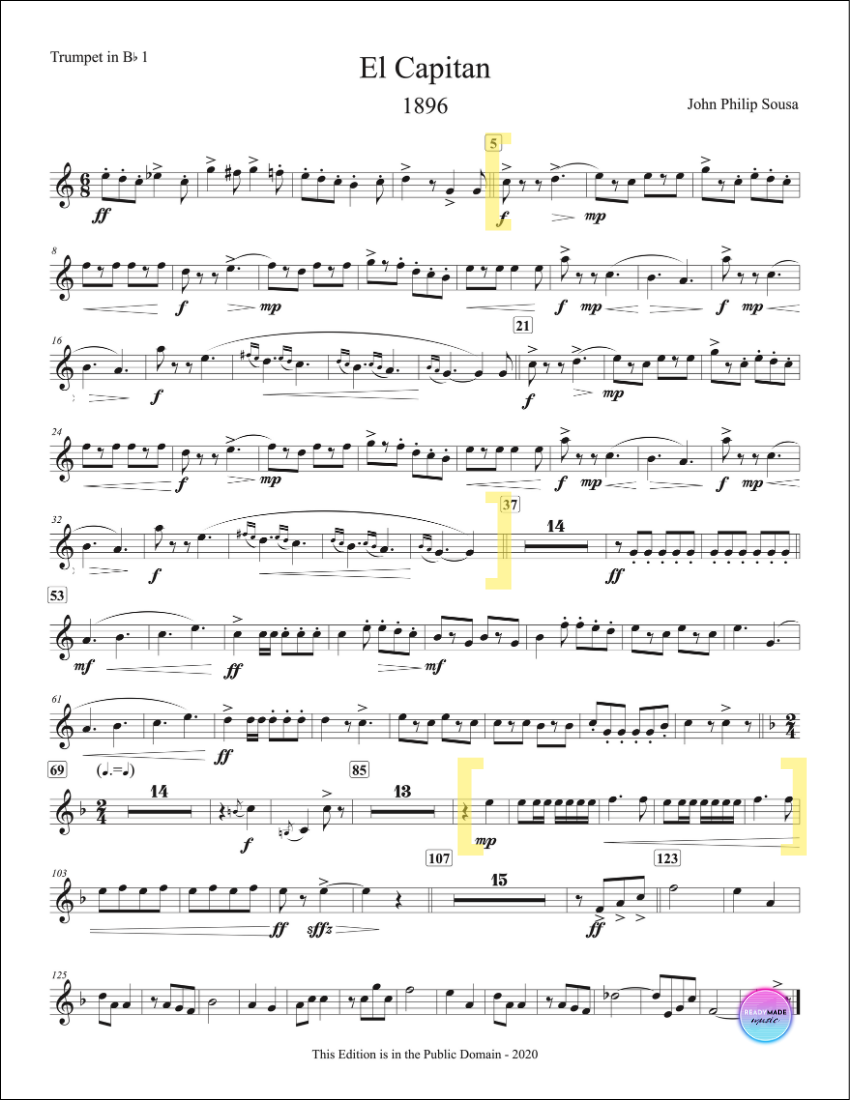
I use a color-coding system to help students know exactly what to practice—and just as importantly, what they don’t need to practice. At the conclusion of the first appointment, everything that needs to be played again at the next appointment is placed in a yellow bracket.
At the second appointment, I hear only the yellow-bracketed excerpts. If a passage is passed off, I write my initials above the bracket to indicate completion. Everything not passed is now marked in red.
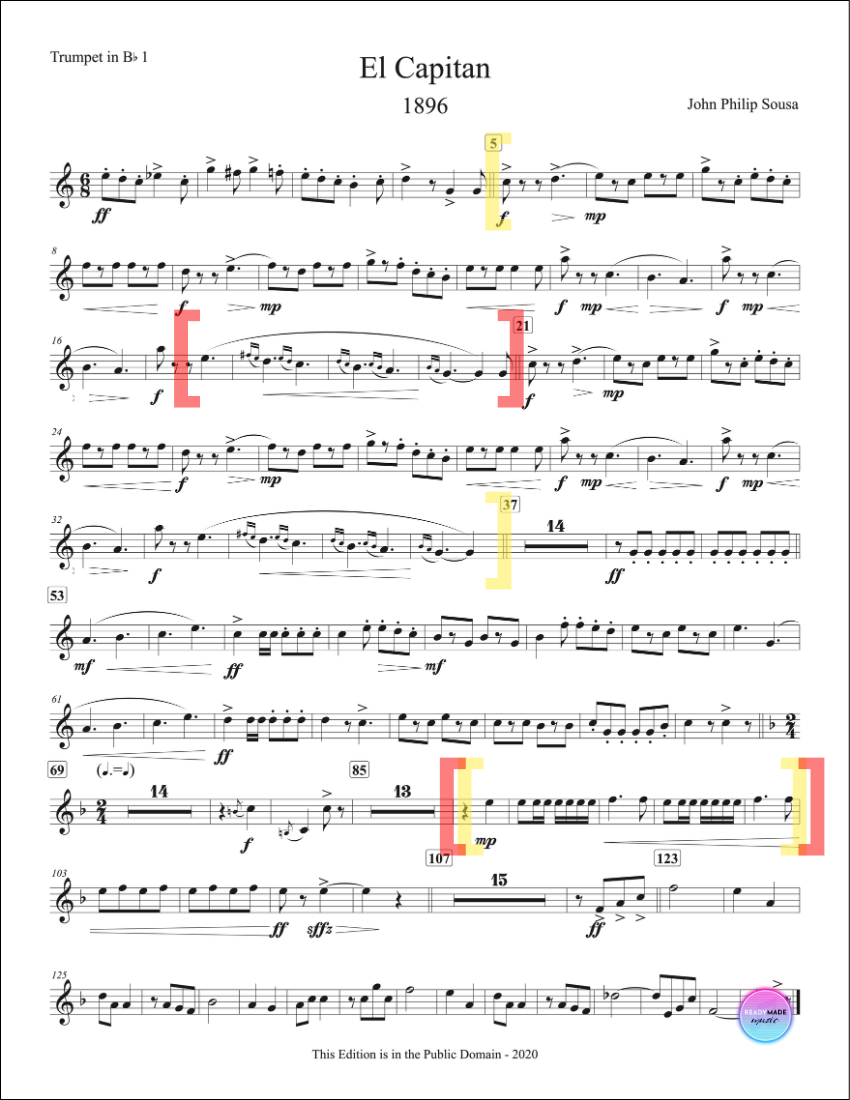
At the third and final appointment, I hear only the red-bracketed excerpts. Everything completed receives an initial and date. Passages not completed are up for modification.
Note: If a student completes everything at the first or second appointment, they don't need to attend further pass-off rounds. This naturally reduces the number of students returning each cycle, which makes later rounds move faster.
Check out our music literacy method!

Modifying Parts
We should do our best to avoid excessive rewrites or trimming. Our literature selections should be achievable by the majority of the ensemble—ideally, where 90% or more of students can wholly perform each piece. That said, there are times when we may need to carefully and thoughtfully modify a student’s part to balance the needs of the individual and the group for a particular performance. I suggest the following approaches:
- Targeted reductions
- Temporary omissions
Targeted reductions involve simplifying specific passages so a student can participate successfully without altering the overall musical structure—for example, reducing a complex rhythm to its skeletal form or rescoring notes that fall outside a student’s range.
Temporary omissions involve the removal of a passage when simplification would distort the musical line. In practice, this may look like a student not playing for a brief section, but still fully participating by fingering along in playing position.
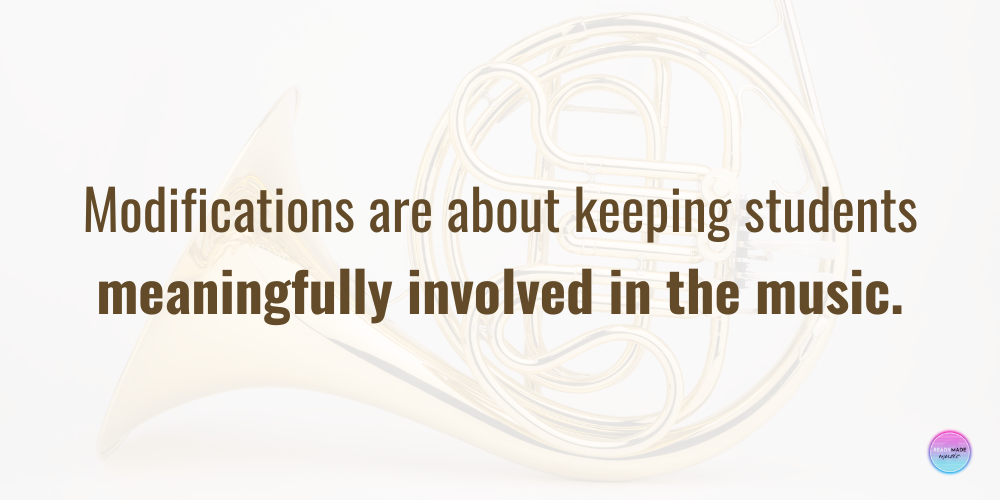
Consider this: In music, there is no bench—we seat all players on stage. When modifying parts, it’s important that we don’t withhold participation, but instead make temporary adjustments that are developmentally appropriate for the individual and musically appropriate for the group—and always keep in mind that modifications are about keeping students meaningfully involved in the music.
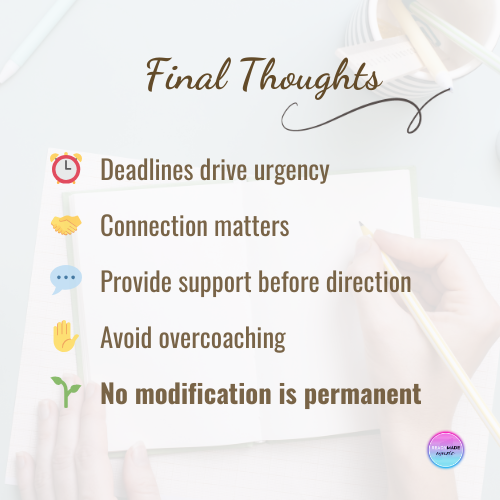
Final Thoughts
Here are some final thoughts I have on these pass-offs from my many years of doing them:
⏰ Deadlines drive urgency.
Build pass-offs into your calendar and communicate them clearly to students so expectations are established well in advance. When students know a deadline is coming, preparation becomes more intentional.
🤝 Personal connection matters.
Students may not remember every piece of feedback we give, but they will remember how we made them feel. A brief, positive interaction during a pass-off can have a lasting impact on motivation and confidence.
💬 Provide support before direction.
Sometimes this is as simple as saying, “Thank you for playing for me today. I know that wasn’t easy. You can do this—let’s talk about where I know you can improve.” Small moments of encouragement help students stay invested in the process.
✋ Avoid overcoaching.
Our job isn’t to do the work for them. Be clear and concise with feedback, then trust students to apply it. Ownership grows when students are given space to problem-solve.
🌱 No modification is ever permanent.
Even after a final pass-off, I remind students that modified passages can always be earned back. The difference is that I’m no longer guaranteeing appointment times—they need to find a moment to play for me outside of regular rehearsals, whether that’s during lunch, advisory, or before or after sectionals.
When used thoughtfully, individual pass-offs don’t just prepare students for contests—they help them learn how to take ownership of their growth. Best wishes for a successful contest season! ✌️
Related post:
Never miss a new posting!

Check out this short video!

About the author:

Rob Chilton is the creator and owner of Readymade Music, LLC and its content. Previously, Chilton was a middle school band director from 2007-2021. His most recent teaching position was the Head Band Director at Killian Middle School in Lewisville, Texas from 2014-2021.
Under his direction, the Killian Honors Band was named the 2018 Texas Music Educators Association CC Honor Band and performed at the annual 2018 TMEA Clinic/Convention. In 2019, the Killian Honors Band was invited to and performed at The Midwest Clinic in Chicago. Additionally, the Killian Honors Band was named a National Winner in the Mark of Excellence National Wind Band Honors Project in 2015, 2016, 2017, 2018, and 2019.
Chilton is a graduate of Southern Methodist University where he had the opportunity to study music education under the tutelage of Lynne Jackson and Brian Merrill. During his years as a middle school band director, Chilton continued his professional growth under the guidance of his primary clinicians, John Benzer and Brian Merrill.
Chilton’s mission for Readymade Music is to promote the overall well-being of music education and support school music teachers by providing solutions to help make teaching music more efficient and inspirational while increasing engagement for 21st century learners.

© 2026 Readymade Music, LLC
All rights reserved.
The unauthorized distribution and/or reproduction of this work is illegal.
