
5 Practical Steps to Encourage Watching the Conductor
Mar 01, 2026
Estimated Read Time: 5 minutes
By Rob Chilton
Help.
That was the thought running through my mind as my ensemble unraveled in front of me. Our performance was just days away and entrances were late, releases wouldn’t line up, and the tempo was drifting.
For years, I assumed their lack of watching was a focus issue. Then I realized I had never really taught my students how to watch—or what to watch for. So I designed a short sequence to fix the problem. Here are five practical steps to encourage students to watch the conductor more often and effectively. Altogether, it takes about 15–20 minutes.
Step 1: Show Them the Pattern
First, I have my students stand up, set their instruments down, and face me. Then I ask them to raise their right hand and mirror me while I conduct a slow 4/4 pattern. As we move through each beat, I say the direction aloud:
“Down, left, right, up.”
I do this mirrored. Meaning, they move with their right hand in the correct directions, and I use my left hand moving the opposite way so they can simply follow what they see. For many, learning the motions is a light bulb moment. They discover there’s a predictable pattern—it’s not random.
Step 2: Find Beat 1
While still standing and conducting in 4/4, I’ll ask the students which direction beat 1 travels. They almost always say “down.” If not, I’ll guide them there. Then I explain that in standard conducting patterns, beat 1 always begins with a downward motion.
Next, I turn it into a simple exercise or game. I conduct in 4/4 and have them count the beats aloud. I tell them I’ll switch to 3/4 and then 2/4 without warning. Their job is to watch for the down stroke that signals beat 1.
After 2/4 time, I go right into 1/4 time. They always get a kick out of this because in 1/4 time, every motion is down. Then, I’ll finish with something ridiculous like 20/4 time just to keep it light—and drive the point home that beat 1 is always down.
Step 3: Locate the Ictus
Once they understand the basics of a conducted pattern and that beat 1 is always down, I’ll show them the ictus. It’s the point in our gesture where the baton changes direction—and where the beat actually occurs.
To help them see it, I create a “platform” with my non-conducting hand and let the baton strike it. Then I remove the platform and keep conducting, showing them that the ictus is still there—it just isn’t visibly reinforced anymore. When students understand and can see where the beat lives, their timing and rhythmic placement improves almost immediately.
Step 4: How & When to Watch
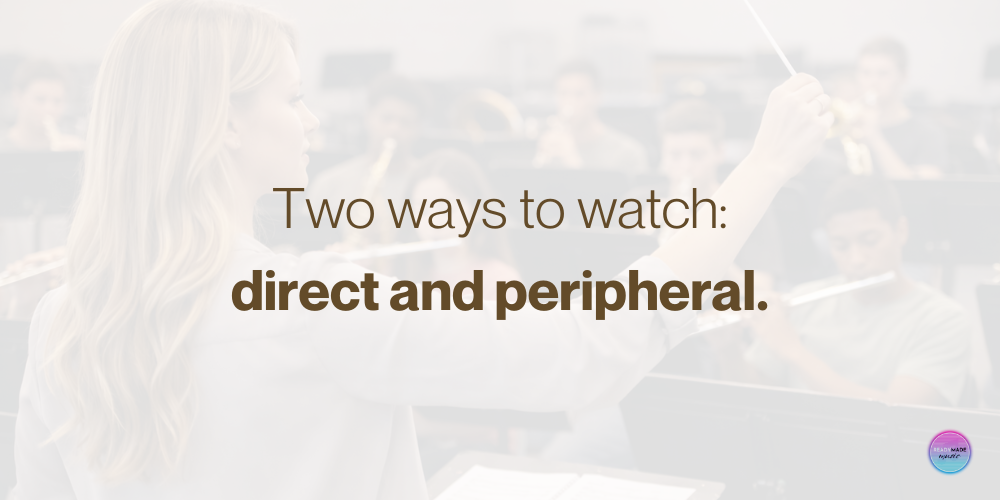
Now that they know what they’re watching for, it’s time to discuss how to watch. I tell students there are two ways to do so:
- Direct
- Peripheral
Direct watching is exactly what it sounds like—intentionally looking up. The most important times to do it include:
- Beat 1 of most measures
- When entering after a period of rest
- At rehearsal marks (measure numbers with a box around them)
- During tempo changes (including accelerandos, ritardandos, etc.)
Until it’s automatic, I find it helpful to have students write reminders in their music to watch directly. Something as simple as writing “look up”—or drawing a small pair of glasses—can work wonders.
Peripheral watching is staying visually aware of the conductor while still reading the music. Even when their eyes are on the page, students should still sense what’s happening in front of them.
In my opinion, peripheral watching is what younger musicians lack the most. They often play with tunnel vision—laser-focused on their sheet music and unaware of anything happening in front of them. To practice peripheral watching, ask them to fix their eyes on one spot in the music and not look up all. Then have them count the beats aloud as you conduct. You can speed up, slow down, or even change meters—just to show them they can still perceive what’s happening without lifting their eyes.
Try this: A fun (or possibly not so fun) game I play with my students is what I call “Look Up or We Stop.” We start a piece from the beginning. If I intentionally make eye contact with a student and they don’t look back within eight beats, we stop and restart from the top. The first few times, there are groans. But if you stay calm and insistent, they get the point quickly. I’ve rarely had to play this more than once. After that, a simple reminder is enough to get them watching better.
Check out our music literacy method!

Step 5: Discuss Recovery Strategies
After going through all of this, I’ll take a few minutes to talk about recovery strategies—what to do when things start to fall apart during a run-through or performance. Young musicians don’t automatically know how to recover. When things go wrong, they tend to bury their eyes in the music, as if staring harder will somehow fix it.
So I teach them that when things seem off, they should look and listen. I tell them: At the first sign of trouble, bring your eyes up. Chances are I’ve already noticed—and I’m working to bring it back together. Second, listen to your neighbors for rhythmic agreement and vertical alignment.

Final Thoughts
Watching the conductor isn’t automatic. We often assume students know how to do it better than they actually do. The truth is most have no idea what to look for—or when it matters most. When we take a few minutes to teach the pattern, identify beat one, locate the ictus, clarify how and when to look, and practice recovery, the ensemble tightens. And confidence grows—on both sides of the podium.
Our conducting should also match our students’ skill level. Less experienced students need more simple time-keeping, whereas more experienced students can process more artistic gestures. I remind myself that our job as conductors is to serve the musicians in front of us. What matters most isn’t how we look on the podium, it’s how the ensemble sounds.

Related post:

Never miss a new posting!

Check out this short video!

About the author:

Rob Chilton is the creator and owner of Readymade Music, LLC and its content. Previously, Chilton was a middle school band director from 2007-2021. His most recent teaching position was the Head Band Director at Killian Middle School in Lewisville, Texas from 2014-2021.
Under his direction, the Killian Honors Band was named the 2018 Texas Music Educators Association CC Honor Band and performed at the annual 2018 TMEA Clinic/Convention. In 2019, the Killian Honors Band was invited to and performed at The Midwest Clinic in Chicago. Additionally, the Killian Honors Band was named a National Winner in the Mark of Excellence National Wind Band Honors Project in 2015, 2016, 2017, 2018, and 2019.
Chilton is a graduate of Southern Methodist University where he had the opportunity to study music education under the tutelage of Lynne Jackson and Brian Merrill. During his years as a middle school band director, Chilton continued his professional growth under the guidance of his primary clinicians, John Benzer and Brian Merrill.
Chilton’s mission for Readymade Music is to promote the overall well-being of music education and support school music teachers by providing solutions to help make teaching music more efficient and inspirational while increasing engagement for 21st century learners.

© 2026 Readymade Music, LLC
All rights reserved.
The unauthorized distribution and/or reproduction of this work is illegal.
